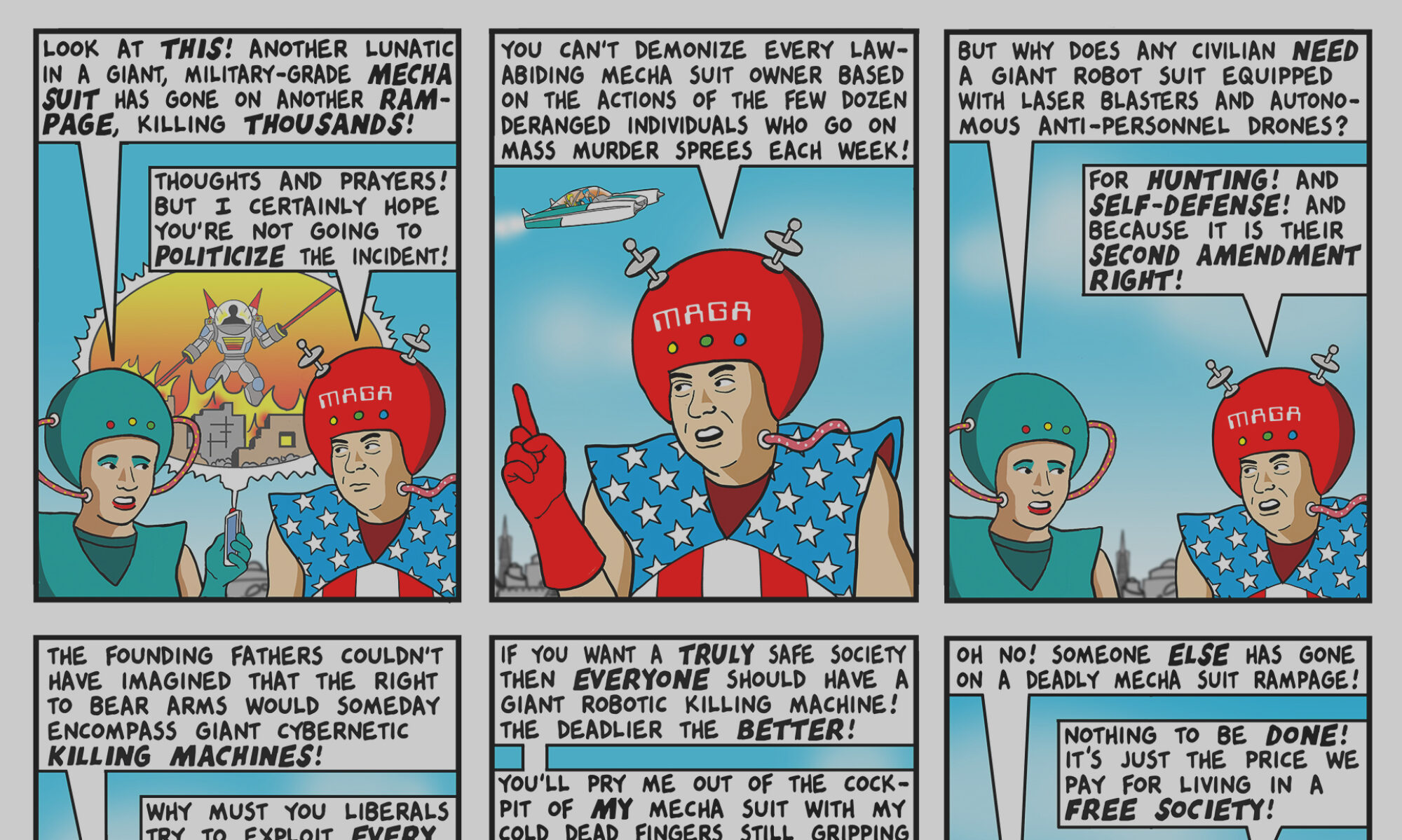
Note: this essay originally appeared in Flaming Hydra; thanks to Maria Bustillos and Zach Rabiroff for editorial guidance.
I grew up on MAD Magazine, and it had a profound impact on both my creative sensibilities and my general outlook on the world. Through the subversive satire of MAD, a whole generation of kids in the 1960s and 1970s learned to distrust advertising, politicians, and authority in general—all of which turned out to be lessons that would serve me well in life. And on a specifically personal note, it’s obvious that I was heavily influenced by the magazine’s text-heavy movie and TV parodies. Whenever someone suggests that my cartoons have “too many words,” I just want to say: have you ever seen an issue of the 20th century’s preeminent journal of satire and whimsical commentary, cleverly disguised as a comic magazine for children?
MAD was published by the legendary William M. Gaines, a man seemingly born to the job. The American comic book itself had, arguably, been invented by his father, Max. In 1933, Gaines père was employed as a salesman at Eastern Color Printing when he took advantage of some unused printing presses to package newspaper comic strips into bound booklets. Funnies on Parade turned out to be an enormous hit, and Gaines went on to found two companies of his own: All-American Publications (later merged into what became DC Comics), and then Educational Comics, or EC for short.

Funnies On Parade (1933) fair use image via Wikipedia
When Max was killed in a motorboat accident in 1947, his n’er-do-well son Bill took over the family business, and within a few years began publishing MAD in its original comic book format, along with a variety of suspense, science fiction, and horror titles—a body of work that would one day land him before a U.S. Senate subcommittee. There, he was interrogated by Tennessee Senator Estes Kefauver, who was less than appreciative of his contributions to American culture.
“This seems to be a man with a bloody axe holding a woman’s head up which has been severed from her body,” Kefauver famously said at one point. “Do you think that is in good taste?”
Gaines responded by defending his artist’s restraint and subtlety, noting that a different composition might have emphasized even more blood.
Within two years of the disastrous hearings, industry censorship and public opprobrium had led Gaines to shutter his comic book line—but not MAD, which had converted to a larger magazine format a year earlier. The rest was history.
* * *
How much did I love this magazine? When I was in my early teens, I’d visit my dad for the summer in Iowa, and I spent a significant portion of my days in the Rare Books room at the University of Iowa library, reading back issues and plugging nickels into a mid-1970s photocopier to make poor-quality, barely-legible Xerox copies of my favorite pieces. Older material from the magazine was also available in paperback anthologies (Certifiably MAD, Raving MAD, etc.), which I’d pored over at an even younger age, struggling to understand the numerous references that predated me, and, by extension, to make sense of the mysterious adult world they parodied. The MAD version of West Side Story was especially perplexing, moving the location east to the United Nations, and turning the rival street gangs into politicians from either side of the Iron Curtain. Since I had never seen the movie, nor had much idea who Khrushchev even was, it was like trying to decode a mysterious artifact that had somehow fallen through a hole in space and time—a key to secret knowledge I could sense, but not quite comprehend.
There were dozens of movies I only knew through their MAD parodies. A while back, I spent a few weeks finally watching some of these, including Lawrence of Arabia—or, as I first knew it, “Flawrence of Arabia.” It was strangely familiar, like a friend I had only ever seen reflected in a funhouse mirror. And I became well-versed in secondhand cultural references, like the fact that the Ford Edsel had been a colossal failure, or that there had briefly been a television show about a man’s mother reincarnated as his car. When I started writing and drawing my own childhood cartoons a few years later—many of them multipage movie satires, drawn on lined notebook paper with a No. 2 pencil—they included punchlines referencing both the Edsel and My Mother the Car. Because I had read the jokes in MAD, and I knew they were funny, even if I didn’t fully understand why.
I could go on, but you get the idea. I was a fan, a devotee, and a student of MAD. I read, and re-read, and re-re-read Frank Jacobs’s 1972 biography, The MAD World of William M. Gaines, immersing myself over and over in the story of Gaines and his ostentatiously zany band of cartoonists (aka “the usual gang of idiots”). Looking back over that book recently, I realized that some of their wacky office pranks were actually just kind of cruel, and from my current vantage point, I was appalled that MAD’s artists did not retain any rights to their own work. Nonetheless, Gaines was the ringmaster of a circus that enchanted and captivated me, and he undeniably created something extraordinary in the process.
* * *
In my senior year of high school in Iowa, I applied for a U.N.-sponsored trip to the East Coast. I had moved around quite a bit as a kid, from Iowa to Florida to Georgia to Arkansas, and eventually back to Iowa; I was a child of divorce, and my mom always seemed to believe in the promise of the next horizon, the fresh start. Which was, in fairness, more of a possibility before the internet settled over us all like smog trapped under an inversion layer. I inherited her restless spirit, and was in a hurry to see more of the world. Within a couple of years I would drop out of college and move to New York City with barely any money in my pocket, and live in Williamsburg long before it was “Williamsburg.” But that’s an essay for a different day.
I was living with my dad at this point, and I saw a way to visit New York that he’d probably allow, despite his deeply small-town distrust of big cities. I submitted some sort of contest essay about the noble purpose of the United Nations, or the vital necessity of world peace, or whatever it was, I honestly have no idea. But it got me on the bus. We drove from Iowa to D.C. and got a tour of the Capitol from our Congressman, stopped in Philly to see the Liberty Bell, and then, finally, arrived in New York City.
We couldn’t have been greener, more clearly from the sticks, myself most of all. I got my first suit for that trip, and I use the term loosely: the salesman sold my father on a camel’s hair jacket and a pair of navy blue slacks, which made me look like a security guard in a mid-tier department store. But here’s the wild thing: somehow, apart from the various structured activities, the trip chaperones basically let a bunch of kids from Iowa run free in late-seventies New York City, unsupervised. And so of course the first thing I did was grab a couple of my buddies and make a beeline for the address I knew so well from the masthead of every issue of my favorite magazine: 485 MADison Avenue.
How we even found our way there, wandering around an unfamiliar and overwhelming city, I don’t really know. But somehow we did, and, I guess, announced that we were teenagers from Iowa here for a visit, and… they invited us right in, which was apparently standard office policy whenever random kids showed up. Longtime MAD editor Nick Meglin gave us a tour of the offices: the stacks of flat files (what I wouldn’t give now to have had a half an hour just to poke around in that treasure trove); a wall covered in sketches from all the artists whose styles I knew so well—Jack Davis, Sergio Aragonés, Don Martin, Al Jaffee.
And then a visit to Gaines’s office.
 Photo: Dan Perkins
He was an avuncular man in his late fifties, with long grey hair swept back from his forehead and what I can only describe as a jolly beard. He wore a short-sleeved pinstriped shirt and thick black-framed glasses, the case for which was visible in his shirt pocket. According to his biography, he was compulsively neat and kept the items on his desk precisely arranged, but all I remember is a chaotic jumble: MAD zeppelins hanging from the ceiling, a giant paper mache King Kong head (designed by Aragonés) peering in through a window.
Gaines greeted us from behind his desk, and then paused and gave me a piercing look and said, slowly and with great intensity, “Young man—you are clearly destined to become a modestly successful cartoonist with a relatively small, yet fiercely loyal, readership.” The lights flickered briefly and the windows rattled as a strange breeze whipped through the room, sending papers and artwork flying off his desk.
Okay, that didn’t really happen. Actually he chatted with us politely for a moment as I snapped a few photos with the Nikkormat I carried pretty much everywhere in those days, and then offered us coupons for something called THE NEW YORK EXPERIENCE, which Google tells me was a “long-running multi-screen extravaganza.” We didn’t use them, but I’ve had a lifetime of New York experiences since then, so I guess it all evens out.
And that’s pretty much it. For a few short minutes, I stood in the presence of this absolute icon, more of a hero to me at that age than any musician or actor—not really a creator himself, but an enabler of creativity, and of cartooning, and satire, and much of what I hold dear in this world. This man who personified MAD Magazine at least as much as the gap-toothed mascot they’d appropriated from turn-of-the-century advertisements and old penny postcards. The moment still looms large in my memory, nearly half a century later: I made the pilgrimage to that shrine of an office, and I shook the hand of the man that made MAD.
 Photo: Dan Perkins